

You don’t have a data & AI problem. You have a value problem.
“We just want all our data in one place.”
It’s been one of the most common ambitions in data for as long as I’ve worked in it, and for many organisations it still is. Cloud migrations, data platforms, lakehouses, transformation programmes: an extraordinary amount has been spent trying to get there.
Now there’s a newer ambition alongside it: “We need to be doing more with AI.” Copilots, agents, automation and a long list of potential use cases. Two different ambitions, with serious investment behind both. And underneath both sits the same question:
How many organisations can confidently say the commercial value created has matched the investment made?
In my experience, not many. And it’s rarely for lack of effort or talent.
Two versions of the same capability
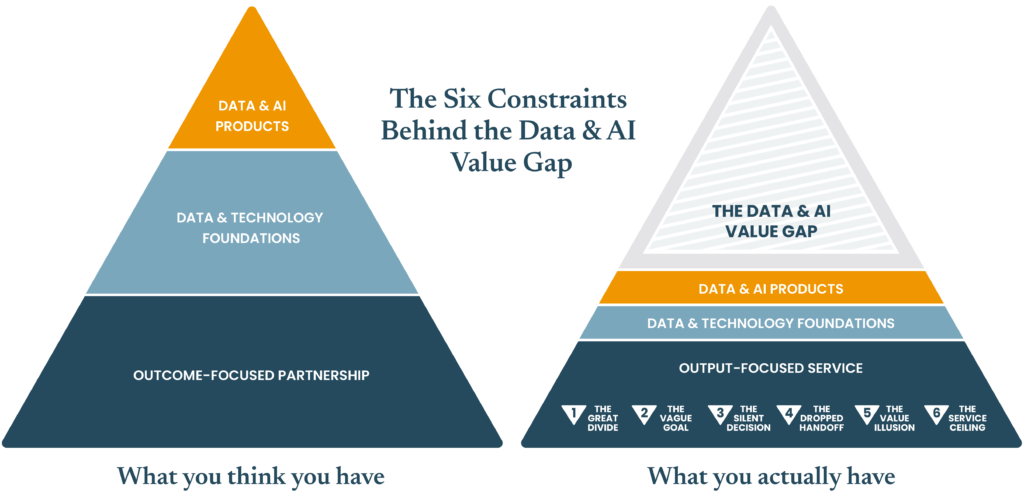
There’s the data and AI capability organisations think they’ve built. And there’s the one they often actually have.
From the top, they look the same. Solid data and technology foundations. Well-built dashboards, models and AI products. Real work, done well.
The difference is underneath. What should hold it all up is a partnership focused on outcomes, where data and the business decide together what matters and what has to change. What I often find instead is a service focused on outputs. Requests come in. Things get delivered. Nobody chose it. It just happened.
That base caps everything built on top of it. However strong the foundations and however clever the products, the value only rises as far as the base allows.
The distance between the two is what I call the Data & AI Value Gap.
It’s not only about the technology
When the value doesn’t arrive, our instinct is to look back at the technology. The data isn’t good enough. The foundations aren’t mature enough. We need a better platform, better tooling.
Sometimes that’s absolutely true. There are often real technical issues to fix. But even when they’re fixed, the value often still doesn’t arrive.
Technology creates potential. Organisational conditions determine whether that potential becomes commercial value. When those conditions aren’t there, the gap opens up.
The six constraints
After 25 years leading data and AI teams and advising executive leadership, I keep seeing the same six constraints behind the Data & AI Value Gap. They show up in traditional analytics, in machine learning, and again now with generative AI.
The Great Divide. Data and AI and the business work side by side, but see the world differently. They use the same words and mean different things. The business says “value” and means commercial impact. The data team says “value” and sometimes means capability delivered.
The Vague Goal. Everyone agrees on an ambition nobody has defined. “Become data-driven.” “Unlock value from AI.” “Get all our data in one place.” Ten people can agree with the words while imagining ten different versions of success.
The Silent Decision. Decisions that need shared commitment get assumed, bundled into other decisions, or made quietly by one side to keep things moving. The decision may be a good one. The people whose commitment is needed to turn it into value just weren’t part of making it.
The Dropped Handoff. Delivery becomes the finish line. The model is ready, the agent is built, the dashboard is live, and everyone can honestly say “I did what I was asked to do”. But someone had to change something in the real world for the value to happen, and nobody owned that journey.
The Value Illusion. When the outcome wasn’t clear at the start, activity becomes the evidence at the end. Dashboards shipped. Models deployed. Agents launched. AI licences rolled out. People trained. The data team thinks “we’re doing loads”. The business thinks “why isn’t my world changing?” Both can be right.
The Service Ceiling. The harder the team works to prove its worth by saying yes to every request (another dashboard, a Copilot rollout, a new agent), the more the organisation treats it as a service. It becomes trusted to deliver what’s asked for, not to help shape strategic decisions.
Six constraints, one system
The constraints don’t operate on their own. Each one creates the conditions for the others. A broad ambition becomes a vague goal because the relationship isn’t strong enough to challenge it. Important choices become silent decisions. Work starts before everyone has committed, so the handoff gets dropped. Activity stands in for value. The team works harder, hits the service ceiling, and the divide widens. And around it goes.
That’s why they’re so hard to shift. They don’t sit inside any one team. They sit between teams. You can’t create a shared goal on your own, or own adoption on someone else’s behalf.
Try this. Ask your data leader what’s holding value back. Then ask your commercial director the same question. You won’t get the same answer. Not because either is wrong, but because they’re standing in different places and describing what they can see from there. Everybody sees part of the system. Nobody sees all of it.
So we fix the part we can see. And the system pulls us back into the same pattern.
Why it matters more now
AI is making it faster and cheaper to build than ever. More models, more agents, more tools. But if the conditions around the technology haven’t changed, more capability doesn’t automatically create more value. It creates more activity.
AI doesn’t remove these constraints. It amplifies their consequences. We can now build the wrong thing faster.
So the question worth asking isn’t “how quickly can we adopt AI?” It’s “have we built an organisation capable of turning what data and AI can do into value?”
Data and AI don’t create value. Organisations do.
If this feels familiar and you’d like an independent view of where value is being constrained in your organisation, every Prospore engagement starts with a Data & AI Value Diagnostic. I’d love to connect.
Helen Mannion is a Data & AI Value Advisor and founder of Prospore. She has spent 25 years in AI, analytics and data leadership, and was recognised in the DataIQ Top 100 for eight consecutive years.